
On Friday evening the UK Government sent an emergency alert to almost every phone in the country warning that dry grass catches fire if exposed to hotness and it could rapidly become a major wildfire.
Phones shrieked. Britain was advised not to set fire to things.
Fair enough.
So I am sending out a second one.
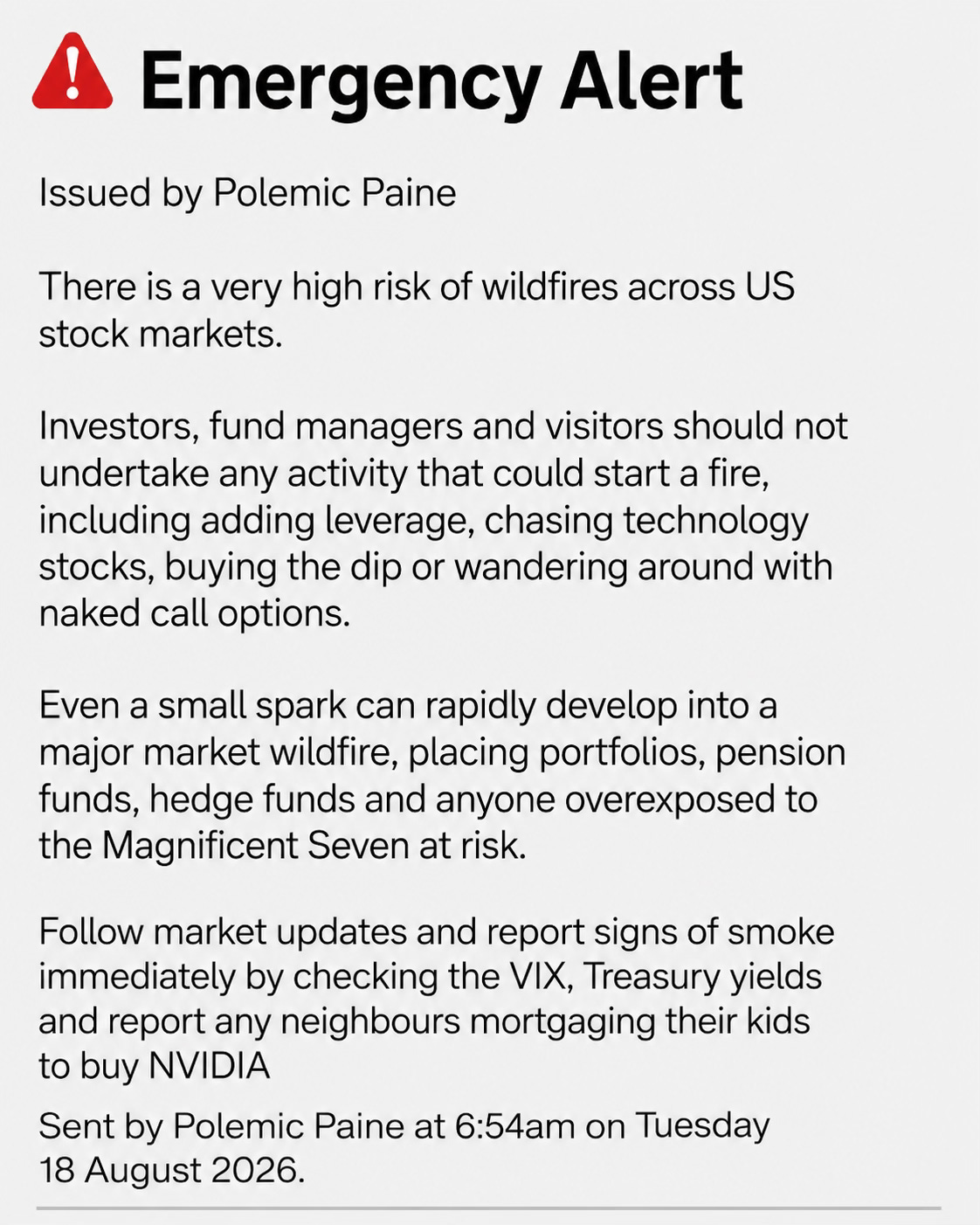
Joking aside, I think the US stock market is going down. I thought the move could begin immediately, so yesterday I stopped watching and put the shorts on in tech and S+P.
I don’t know whether the S&P falls this afternoon, squeezes another few per cent higher first, or just craters 10, 20 or 30 per cent. To be honest, that is the sort of smug get out clause that most people say to extend their chance of not being as wrong as they could be. So let’s not hedge, though I do have a terrible habit of being 2 days early but this is conviction about direction and clairvoyance about timing. Just to counter those who say no one can be clairvoyant in markets. Markets have a wonderful habit of making you look like an idiot immediately before proving you right. But I’m a big boy and if I‘m wrong I can wear it, over all the other jackets of wrong in my ‘I’ve been wrong wardrobe’.
We have spent most of this year watching the spring wind tighter. Things that ought to have wobbled other things hadn’t. Every wobble had been bought, every nasty surprise absorbed and every reason for caution overwhelmed by the belief that US equities ultimately only travel in one direction.
The market ground is dry, the sparks are starting to land and there is rather a lot of wind about.
The dry tinder
All of this has been true for months. It explains why the market can burn, not why I think someone may have just dropped the match.
US equities are historically expensive. The S&P trades around 20 times forward earnings and the Shiller CAPE is above 40, only this time those multiples sit beside high bond yields rather than the near-zero rates which once helped excuse them.
The equity risk premium is wafer thin. Investors are being paid remarkably little to own equities rather than government bonds.
The index increasingly looks like a handful of AI capex stories wearing a diversified index costume.Hyperscaler spending is heading towards levels where a few companies may soon outspend the rest of the S&P 500 combined, with an increasing amount of that infrastructure financed through debt.
FINRA margin debt touched roughly $1.5 trillion and, even after July’s shake-out, remains near $1.4 trillion, almost 40 per cent higher than a year ago.
Hedge-fund leverage is stretched. Prime-broker exposure is near record levels and some quantitative equity books are running extraordinary gross leverage.
Leveraged ETF assets hit roughly $218 billion before July’s wobble, heavily concentrated in technology and semiconductors.
Options activity is running at records, accompanied by enormous demand for upside calls and all the synthetic leverage that comes with them.
Passive US funds now hold roughly $22 trillion, automatically directing fresh money towards the companies whose market values have already risen the most.
The fiscal position is dreadful without even having the excuse of a recession. Deficits are enormous, Treasury issuance is relentless and interest costs are climbing.
There is plenty of weakness underneath the shiny index. Housing is anaemic, household credit is stretched and corporate failures and restructurings remain elevated.
Dry grass can lie there for weeks. Valuation, leverage and fiscal excess are the field. The match is normally dropped by a visitor of unexpected news.
The Rolls-Royce gauge
There is one indicator in all this that I take particularly seriously.
I have followed Bank of America’s Bull & Bear Indicator for about two decades, or at least for as long as I can remember it existing. At its extremes I have found it remarkably reliable.
Since then everybody seems to have invented a bull-bear gauge. Banks have them, brokers have them, research houses have them. Some are useful. Some appear to have been constructed mainly because BofA had one and people paid attention to it.
For me the BofA indicator remains the Rolls-Royce. It pulls together flows, positioning, credit, sentiment and other market measures rather than sticking a wet finger in the air and calling it a fear gauge.
It is currently at 9.7 out of 10.
A 9.7 says investors are already standing on the bow of the boat with the front hatch open. It is a positioning signal, not a clock.
When the Rolls-Royce gauge is hard against the stop, I listen.
The market has been trained
This may be the most dangerous part of the whole setup. Markets have spent 2026 learning that everything is survivable.
Iran - buy the dip. Tariffs - buy the dip. Oil shock - buy the dip. Weak jobs numbers - buy the dip. Tech sell-off - buy the dip. Bond yields higher - buy the dip.
Every scare has passed and every recovery has reinforced the behaviour. This is conditioning like car aircon in a UK heatwave. You can drive for miles in 40C of heat thinking everything is just balmy outside.
It is how you end up with war in the Middle East, oil around $90, long bond yields at levels we haven’t seen for years, the S&P near record highs and the VIX sitting placidly in the mid-teens.
Each hot day which fails to start a fire makes the next one seem less dangerous. Meanwhile the field keeps drying out.
Why today
For months the bear case consisted mostly of static facts. Expensive, crowded, leveraged and fiscally reckless.
All true but all useless for timing.
What has changed is that some of the assumptions which allowed the market to ignore those facts are beginning to fail at the same time.
The consumer is wobbling
July retail sales fell 0.6 per cent and the control measure fell too, consumer sentiment dropped sharply and one-year inflation expectations rose, while employment momentum has weakened materially, removing a support which until recently looked almost indestructible.
A weakening consumer and collapsing inflation would be easy. The Fed rides over the hill, cuts rates and everybody goes home happy. A weakening consumer while inflation refuses to disappear is a much nastier beast, and it is the beast the bond market is currently pricing.
The bond market is refusing to help
The 30-year Treasury yield has pushed above 5.3 per cent, its highest since 2007, long real yields have moved above 3 per cent, and Japanese government yields are simultaneously at multi-decade highs, so this is no longer merely an American problem.
The July federal deficit was roughly $432 billion, fiscal-year borrowing is already closing in on $1.8 trillion, and AI-related corporate borrowing is adding yet more demand for long-duration capital.
Weak data is supposed to bring long yields down.
It isn’t.
For years the sequence was wonderfully convenient. Bad news brought an easier Fed, an easier Fed brought lower yields, and lower yields brought higher equity multiples. I am watching for a different sequence, where bad news meets a Fed trapped by inflation and long yields stay high anyway.
That leaves expensive growth stocks with weaker prospective earnings and no compensating fall in the discount rate. At 20 times forward earnings, that starts to bite rather quickly. More than any individual spark below, this is what moves the trade from eventually to now.
Iran is escalating again
The truce has expired, talks have stalled and tanker attacks and seizures have returned.
Shipping through Hormuz has deteriorated sharply, Brent has turned back above $90 and diesel and refining markets remain tight, feeding the energy shock straight into freight, farming, manufacturing and eventually the consumer.
The number on Brent tomorrow morning interests me less than the change in direction. The market had started pricing normalisation. The news has turned the other way.
The rest of the tinder box is filling up too
Global food prices on the FAO index are at a three-year high, Black Sea grain and sunflower-oil flows remain exposed to the Russia-Ukraine war, and El Niño is adding weather risk across coffee, cocoa, sugar and edible oils.
Helium, critical to semiconductor manufacturing, is being squeezed by disruption in Qatar, Russian restrictions and Chinese export controls just as AI-driven chip demand goes vertical.
China remains weak, removing one more potential source of global demand.
Any single one of these is manageable. The interesting bit is that they are arriving together. Oil and diesel are tight, food prices are rising, fertiliser is under pressure and helium is being squeezed just when semiconductor demand is exploding.
The global economy has fewer spare chairs each time the music stops.
Gold sneakily going back up
Gold has bounced hard in August despite high long-term rates. Silver has followed in its noisier way.
Gold was written off earlier this year after conspicuously failing to behave like a safe haven during the first Iran shock. Now it is back.
That makes me go hmmm. One market appears to be rediscovering an appetite for protection against inflation, geopolitical trouble and fiscal risk while US equities remain serenely unbothered.
The index is the trade
Concentration counts because the S&P itself has increasingly become the AI trade.
A handful of enormous companies carry the benchmark. Passive flows automatically feed them. Options dealers hedge around them. Hedge funds crowd into them. Their capital spending has become an increasingly important part of US investment.
That works beautifully while the AI spending curve keeps going almost vertically upwards.
The bar is disappointment, not failure.
The internet changed the world and still managed to lose investors fortunes. Railways transformed economies and produced magnificent bubbles along the way.
A technology can be revolutionary and its stocks ludicrously priced at exactly the same time.
Serious people are starting to blink
I have no interest in padding this with people who have successfully predicted seventeen of the last three bear markets. The recent warnings are more interesting.
Bank of America’s Bull & Bear Indicator is at 9.7 and Savita Subramanian’s S&P target remains below the current market.
Leon Cooperman has just turned negative on equities, expecting economic weakness to drag markets lower.
The ECB has just explicitly flagged the risk of a US technology correction, while accepting that AI itself may prove transformative.
Wells Fargo’s composite sentiment model has reached its strongest sell reading since 2018, while Ned Davis Research is seeing deterioration in important internal indicators.
I particularly like the ECB argument because it avoids the tedious question of whether AI is real.
Of course it is real.
The price being charged for owning its future is the interesting bit.
The charts, briefly
S&P momentum is beginning to diverge, with fresh highs arriving on weaker RSI underneath.
Several technical and sentiment measures are deteriorating, including Wells Fargo’s sell signal and Ned Davis’s weakening High-Low Logic.
July showed how quickly the Nasdaq can fall through technical levels, although the main indices remain above their long-term moving averages and breadth is still reasonably healthy.
That last part counts for something. A chart already screaming bear market would mean I am already late.
And the calendar
September has historically been the weakest month for the S&P, volatility tends to build from late August into October, and in US midterm years the August-to-October window has historically produced an average pullback of roughly 7 per cent.
August liquidity is traditionally thin, giving the market less depth when an unwelcome surprise lands.
I don’t believe markets fall because somebody turns over a calendar page. But if the field is already tinder-dry, late August is a rather appropriate time to start checking where everyone left the matches.
The wind
The spark starts the fire, and leverage decides what happens next.
Conventional leverage remains enormous, with margin debt above $1.4 trillion alongside very high hedge-fund prime-broker exposure.
Synthetic and systematic leverage sits on top of it, through leveraged ETFs, record options activity, CTAs and volatility-control strategies which can all amplify a falling market.
The same handful of AI stocks sit underneath much of the structure, through crowded hedge-fund positioning, dealer hedging and cap-weighted passive flows.
A modest decline raises volatility. Rising volatility forces some strategies to de-risk. Falling prices trigger margin calls. Hedge funds reduce gross exposure. Dealers rehedge. CTAs cross trend levels.
At some point the selling stops being an opinion and becomes an instruction.
July provided a useful demonstration. A modest technology wobble caused real deleveraging in parts of the market, yet within weeks people began putting the risk straight back on. The lesson they learnt was that the dip worked again, not that the leverage underneath it was dangerous.
I have watched that lesson get relearned every year since the GFC. I don’t expect this to be the year the market finally listens either, right up until the point it has no choice.
The Polometer
Before I go, one more instrument. Not the Rolls-Royce gauge. This one I built myself, in the shed, out of bits and pieces acquired over the course of my financial life, and it is flashing red. Of course it is, I back engineered it to fit my story, which modern storyteller would not?
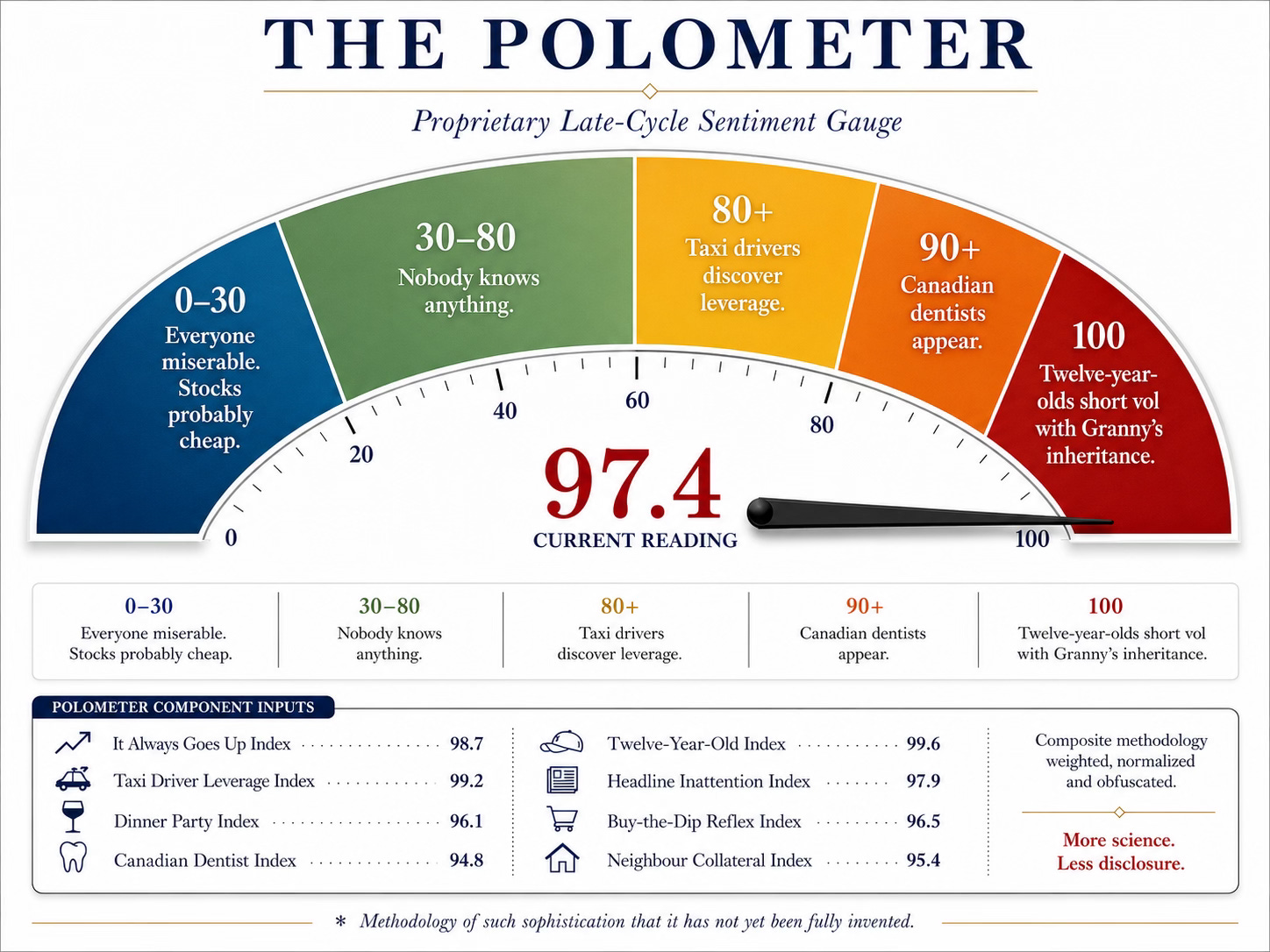
The Gauge is built from highly complex secret bespoke components designed to give off an aura of Nobel Prize level brilliance, but I am willing to divulge these ground breaking econometric components in its composition.
It Always Goes Up Index. Number of people confidently telling me stocks always come back, even after falling a great deal, usually said by a passive investor.
Taxi Driver Leverage Index. Not simply long stocks. Leveraged long. On margin. In the cab.
Dinner Party Index. Number of highly credentialled people from fields with no connection whatsoever to finance announcing that they are long equities. Historically overweight sociology professors.
Canadian Dentist Index. Number of Canadian dentists explaining their momentum stock positions to people who did not ask and cannot leave.
Twelve-Year-Old Index. Number of parents mentioning, with a faint note of pride, that their child has given up on a summer job in favour of trading Granny’s inheritance.
Headline Inattention Index. Real seriousness of the news divided by the amount of attention anyone is paying it.
Buy-the-Dip Reflex Index. Speed with which bad news becomes an excuse to buy more Nvidia.
Neighbour Collateral Index. Number of otherwise sensible people apparently willing to mortgage the house, the dog and the children to buy a stock that has already tripled.
Current reading, 97.4.
The remaining 2.6 points are reserved for the first twelve-year-old to short volatility using Granny’s inheritance.
Emergency Alert
I went short on 17 August 2026.
The dry tinder has been sitting there for months, valuation, leverage, concentration, passive flows, AI expectations and fiscal excess.
The short went on yesterday because the sparks had started arriving together. Iran is deteriorating, oil is turning higher, the consumer is weakening, inflation risks are returning, food prices are rising, long yields are refusing to fall, gold is moving and the calendar is turning. And the fire crews are away on their summer holidays.
All of it is landing on a market still priced for remarkably little to go wrong
So yes, this is a prediction I have already acted on. I think US equities are going down, and I think the move could begin immediately.
I may be early. It may never happen. Or the markets may collapse today leading me to a career on financial TV as the man who saw the great 2026 extinction event coming.
Or … nothing will happen and we’ll pretend I never wrote this.
—————————————————————-
STOP PRESS !
We have just had the three minute warning!
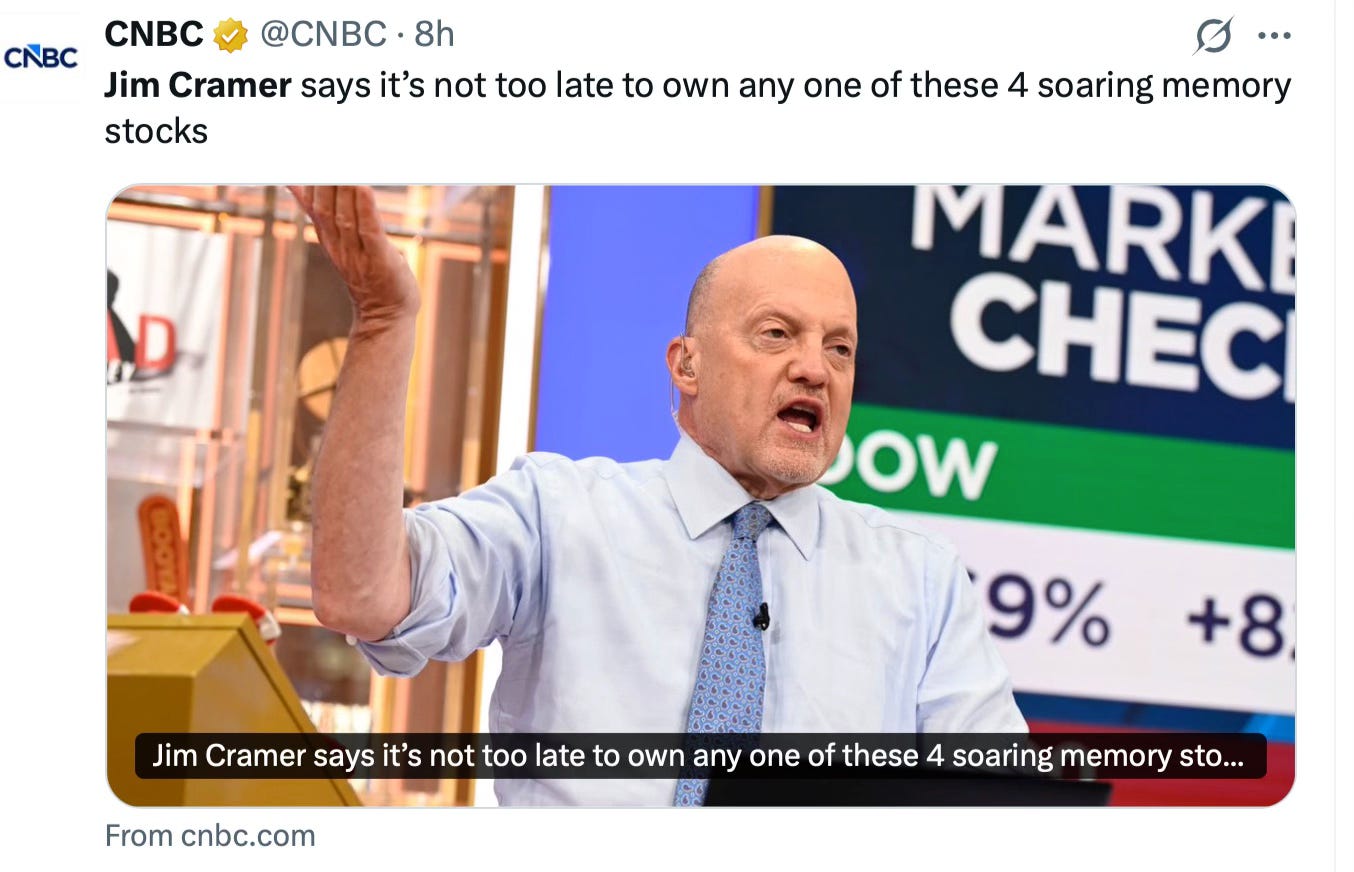
I have to add here, as everyone seems to after giving a complex reasoned argument for them doing something in the markets, that this is not investment advice, in the same way that a blind electrician says ‘don’t try this at home’ while trying to splice in Hinkley Point C’s output to his golf cart in a thunderstorm.
Dance nearer the exit, and pay the doorman to let you and yours out first if the music stops unexpectedly.
I don't mean to blow the proverbial smoke too much, but that was a tremendous read, on a stack that I enjoy reading anyway. And I laughed more than once. I wish I could play it like Barron, but my own PF will likely take a bit of a rinsing. It's my work pension that will get chopped up because such a large portion of that is exposed to exactly this risk. Although a part of it is self-directed, I can't do anything about the rest, or even that much about the part. Maybe my eyes on early retirement have to be lifted from the foreground and into the middle distance. So long as I don't have to start looking at the horizon I can probably handle it. In the meantime, with a long dated bond ETF already on the books and presently underwater, obviously, why wouldn't it be, maybe now is time to pick up my first ever short ETF because like the long bond they are absolutely buried at the moment.
Cheers.